Tags: #notes
Links: Dashboard General Psychology
Personality
Definition:
Individual's pattern of behaving, thinking, feeling,
Four approaches to personality
Trait approach
What is a trait
- Specifc aspect of personality
- Adjectives to describe how a person typically acts, thinks, feels
Small number of basic traits?
How did they research?
- Questionaires. Pattern responses
There are a small number of basic traits
About 5 "5 factor analysis of personality or BIG FIVE"
Each trait is independent (No Correlation between traits) - Chart
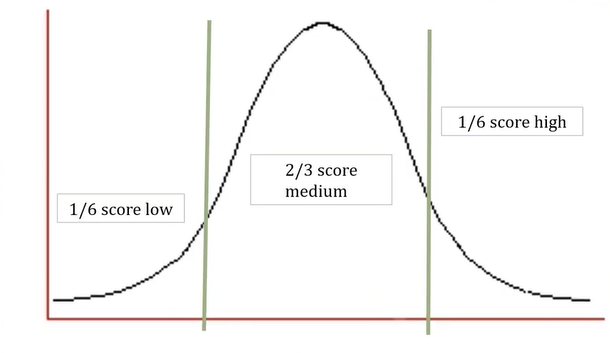
Big 5 Personality trait Test
- 4
- 2 (4)
- 3
- 5
- 2
- 4
- 3
- 5
- 3
- 5(1)
- 5
- 2
- 1 (5)
- 4
- 2
- 4 (2)
- 2
- 4 (2)
- 5 (1)
- 2
- 4
- 3
- 2
- 4
- 3
- 3
- 2 (4)
- 5
- 4
- 2
- 4
- 2
- 2 (4)
- 4
- 4 (2)
- 3
- 5
- 1
- 2
- 4
- 4
- 3
- 3
- 3
Trait 1: 24 (ranking: Medium) Amirvert
Trait 2: 39 (ranking: High) Agreeable
Trait 3: 30 (Ranking: Medium) Conscientious Middle
Trait 4: 14 (Ranking: Low) non-neuroticism
Trait 5: 32 (Ranking: Medium) Intellectance Medium
Trait 1: Extroverision Vs. Introversion vs Ambiversion
High: Extroversion
Medium: Ambervision
Low: Introversion
Extroversion
- Talkative
- Assertive
- Sociable
- Adventurous, risktaking
- Engergetic (active)
- Postive emotions
- Huggers
- Below optimal level of arousal (drink more coffee)
Introversion
- Quiet
- Submissive
- Prefers small group, alone
- Cautious
- Less energy (lower activity)
- Content, serious
- Reserved
- Above optimal level of arousal
Trait 2: Agreeableness vs. Disagreeableness
High: Agreeableness
Low: Disagreeableness
Agreeableness
- Soft-hearted
- Good-natured
- Trusting
- Forgiving
- PEaceful
- Forgiving
- Sincere
- Cooperative
- Kind, Caring
Disagreeableness
- Tough
- Irritable
- Cynical
- Holds grudges
- Argumentative
- Vengeful
- Manipulative
- Rude, Indifferent
Trait 3: Conscientiousness vs. unconscientiousness
High: Conscientiousness
Low: unconscientiousness
Conscientiousness
- Organized
- Careful
- Reliable
- Hard worker
- Tide,punctual
- Self-disciplined
- Ambitious
unonscientiousness
- Disorganized
- Careless
- Unreliable
- Lazy, often sloppy
- Weak-willed
- Aimless
Trait 4: Neuroticism vs. non-neuroticism
High: Neuroticism (Lot of negative emotions)
Low: non-neuroticism
Neuroticism
- Anxious
- Worries
- Sad
- Emotionally unstable
- Insecure
- Self-conscious
Non-Neuroticism
- Relaxed
- Calm
- Not sad
- Emotionally stable
- Secure
- Not self-conscious
Trait 5: Openness to experience vs. Not Open
aka Intellectance vs. Nonitemllctance
High: Intellectance
Low: Nonintellectance
Intellectance
- Curious
- Enjoys ideas
- Abstract analytical
- Philosophical
- Creative
- Appreciates the arts
- variety
NonIntellectance
- Narrow interests
- bored by ideas
concrete
Philosophy waste of time
Down to earth
Non interested in art
Routine
Situations and traits
Party vs College is a big difference bc of situation
- Situation matters
- Traits can be used to predict things (behavior)
- Researchers have looked at gender differences in the big five
- Indivudual's personality change or say the same? Moves non-dirastically
- What is the origin of traits?
- Biology (determines range)
- Environment (determines specific)
Freud (Chapter 11)
Reminder:Freud is not respected within the psychological community. Many of his ideas are not falsifiable. The most accepted is the idea about the unconscious.
- Sigmund Freud was born in Austria in 1856. He died in England in 1939 (he was Jewish and so left Austria because of the Nazis). He was a medical doctor, not a psychologist. No such degree existed.
- Freud was the first to systematically study and theorize the workings of the unconscious mind in the manner that we associate with modern psychology.
- The unconscious id contains our most primitive drives or urges
- Wants instant gratification regardless of consequences
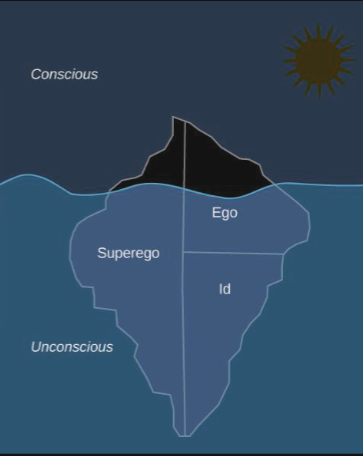
- the ego and superego develop to control the id.
- They are developed through interactions with ones parents and others within the environment of the child
- The Super Ego is developed by a child learning the social rules and what is right from wrong; our conscience
- The Ego is the rational part of our personality.
- Freud considered this to be the self that others saw
- The ego helps the id satisfy its desires in a realistic way.
- Imbalances can lead to neurosis (according to frued)
Psychosexual Development
In each psychosexual stage of development, the child’s pleasure-seeking urges, coming from the id, are focused on a different area of the body, called an erogenous zone. The stages are oral, anal, phallic, latency, and genital
Chapter 11 Excerpt Notes
- Albert Bandura
- Prof of psych at Sanford
- Agreed with skinner than personality develops through learning
- Disagreed with Skinner's behaviorist approach to personality development bc that thinking and reasoning are important components of learning.
- He presented the social-cognitive theory
- died in 21 at 95
Social-Cognitive Theory
Reciprocal Determinism
- Proposed by Bandura (1990)
- Cognitive processes, behavior, and context all interact, each factor influencing and being influenced by the others simultaneously.
- Cognitive processes
- all characteristics previously learned
- including beliefs
- expectations,
- personality characteristics.
- Behavior
- Things we do that may be rewarded or punished
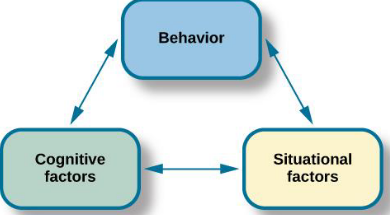
- Context
- Reward structure for the behavior
Observational Learning
- Much of learning is vicarious
- We learn by observing other behavior and its consequences
Self-Efficacy
- Bandura(1977,95) studied cognitive and personal factors that affect learning and personality development.
- Self-efficacy is our level of confidence in our abilities developed through our social experiences.
- Affects how we approach challenges and reach goals
- Situational
- High self efficacy
- Believe goals are within reach
- Positive view of challenges
- Develop deep interest in and strong commitment to activities
- Quickly recover from setbacks
- Low Self-efficacy
- Avoid challenging tasks bc of doubt of ability
- focus on failure and negative outcomes
- Lose confidence in ability if setback.
Julian Rotter and Locus of Control
- 1966
- Proposed locus of control
- Refers to our beliefs about the power we have over our lives
- Internal or external locus of control
- Internal
- Believe outcome are result of efforts
- External
- Out comes are beyond control

The Humanistic Approach
- developed as a reaction both to the pessimistic determinism of psychoanalysis, with its emphasis on psychological disturbance, and to the behaviorists’ view of humans passively reacting to the environment, which has been criticized as making people out to be personality-less robots.
- does not suggest that psychoanalytic, behaviorist, and other points of view are incorrect but argues that these perspectives do not recognize the depth and meaning of human experience, and fail to recognize the ability to choose to change oneself and transforming personal experiences. This perspective focuses on how healthy people develop.
- Abraham Maslow
- Pioneering Humanist
- Studied people who he considered to be creative and productive.
- Included Albert Einstein, Eleanor Roosevelt, Thomas Jefferson, Abraham Lincoln, and others.
- Such people had similar characteristics
- being open, creative, loving, spontaneous, compassionate, concerned for others, and accepting of themselves
- hierarchy of needs theory
- proposes that humans have certain needs in common and they must be met in order.
- Highest need is self-actualization.
- Believed that emotional and behavioral concerns are as a result of failing to meet these needs.
- Carl Rogers
- Humanistic theorist
- Self-concept (thoughts, feelings about ourselves)
- Ideal self: Person you'd like to be
- Real self: Person you are
- We need to achieve consistency between the two
- We experience congruence when our real and ideal self are very similar.
- Parents can help their children achieve this by giving them unconditional positive regard, or unconditional love
- Incongruence is when there is a large discrepancy between the two
Biology and Personality
Minnesota Study of Twins
- Well known (1979-99)
- Studied 350 pairs of twins (identical and fraternal)
- Identical twins have very similar personalities whether raised together or apart
- Heritability of some personality traits
- Heritability: the proportion of difference among people that is attributed to genetics.
- Over a 0.5 heritability ratio
- Leadership, obedience to authority, a sense of well-being, alienation, resistance to strass, and fearfulness
- Determined by a combination of many genes and epigenetic factors.
Temperament
- Contemporary psychologists believe temperament has biological basis bc of appearance very early in our lives
- Environmental factor and maturation can affect the ways in which children's personalities are expressed
- Two dimensions of our temperament, reactivity and self-regulation
- Reactivity is how respond to new or challenging environmental stimuli
- Self-regulation refers to our ability to control that response
Culture and Personality
- Personality is shaped by both genetic and environmental factors
- Culture is a most important environmental factor
- Culture:
- beliefs, customs, art, and traditions of a particular society
- Transmitted via language and modeling
- Personality traits vary across cultures
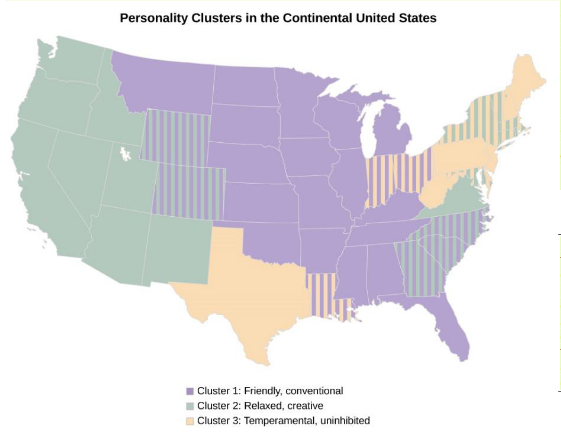
Personality in Individualistic and Collectivist Cultures
- Individualistic believe that independence, competition, and personal achievement are important
- Individuals in Western nations such as the United States, England, and Australia score high on individualism
- People who live in collectivist cultures value social harmony, respectfulness, and group needs over individual needs.
- Individuals who live in countries in Asia, Africa, and South America score high on collectivism
- individualist cultures displayed more personally oriented personality traits, whereas people in collectivist cultures displayed more socially oriented personality traits.
- Frewer and Bleus (1991) conducted a study of the Eysenk Personality Inventory in a collectivist culture using Papua New Guinean university students. They found that the results of the personality inventory were only relevant when analyzed within the context of a collectivist society. Similarly, Dana (1986) suggested that personality assessment services for Native Americans are often provided without a proper recognition of culture-specific responses and a tribe-specific frame of reference. Assessors need to have more than a general knowledge of history, tribal differences, contemporary culture on reservations, and levels of acculturation in order to interpret psychological test responses with a minimal bias.