Tags: #notes
Links: Dashboard General Psychology
Learning
Learning
- Definition:
- A relatively permanent change in behavior due to experience
- Classical Conditioning (First Theory of Learning)
- Learning by association
- Discovered by accident by a Russian scientist Ivan Pavlov
- Expert in digestion
- Studied dogs' saliva
- The dogs began to salivate too soon, when they heard the footsteps
- Bell (taught salivation via bell)
- Lights (taught salivation via light)
- Stimulus
- anything that leads to a reaction
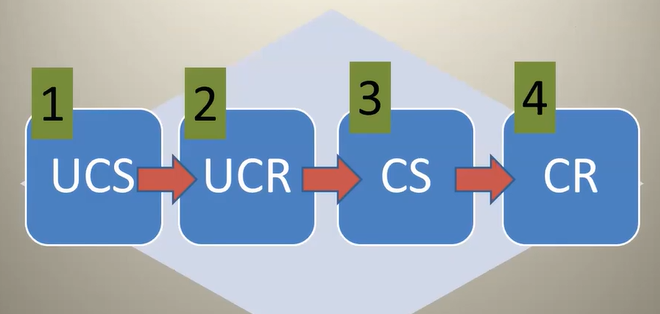
- Unconditional stimulus
- doesn't have to be learned. The subject automatically reacts to it
- Food is an unconditioned stimulus (UCS)
- Conditioned Stimulus (CS)
- Subject learned to react to it
- Response
- The reaction to stimulus
- Unconditioned response (UCR)
- Response that happens automatically ,no learning is required
- Conditioned response (CR)
- Response that is learned
- Chart
- Extinction
- If the conditioned stimulus is no longer paired with the unconditioned stimulus, the conditioned response will eventually stop.
- Generalization
- Subject responding to a similar, but not identical stimulus
- Discrimination
- Subject not responding to similar stimulus
John Watson
- The first person to experiment to see if classical conditioning works with humans
Operant Conditioning
Discovered by B.F. Skinner
- Learning to do rewarded behaviors, learning not to do punished behaviors.
- Skinner box
- Glass cage for a rat
- "Conditioning Chamber"
- See if the rat could learn to press a button that provides him with a reward
- Shaping: Rewarding Each step toward the goal behavior
- Reinforcement
- Reinforcement means increasing the chances of a behavior
- Positive Reinforcement means increasing the chances of a behavior by giving the subject something s/he likes
- Negative Reinforcement increases the chances of a behavior by taking away something the subject does not like
- Punishment
- any thing that makes a behavior less likely
- Opposite of reinforcement
- Disadvantages
- Negative Atmosphere
- Behavior may be stopped only when punisher is around
- Doesn't teach what to do
- Difference between between Classical and Operant Conditioning
- Classical
- Involuntary
- Order: Event in environment comes first, behavior of a subject second
- Operant
- Voluntary
- Order: Behavior of subject comes first, is followed by event in the environment.
- Classical
Behaviorists are not always right. People still learn without punishment or reinforcement.
- Latent-Learning is learning without reinforcement or punishment or even behavior
- The cognitive perspective assumes that our thoughts are cognizant about the environment is what determines behavior
Learning by observation (Modeling)
by Albert Bandura
Who do we see as our models
- Similar
- Respected
- Seen as successful
Learning by insight
Developed by Kohler
- Thinking about a problem and learning to solve it
- Monkey put sticks together and stacked boxes
Philosophical perspectives, 4 Theories of learning
- Behaviorist
- Classical conditioning
- Operant conditioning
- Cognitive
- Observational Learning (Modeling)
- Insight