Tags: #notes
Links:
Reading - Intro to Abnormal Psychology
DSM-5
The Diagnostic and Statistical Manual of Mental Disorders (5th ed., DSM-5; American Psychiatric Association [APA], 2013)
The Views of Abnormality
The DSM-5 is the most widely used classification system for mental disorders. It involves 3 important components:
- (a) involves a significant disturbance in thinking, emotional regulation, or behavior caused by a dysfunction in the basic psychological, biological, or developmental processes involved in normal development;
- (b) causes significant distress or difficulty with day-to-day functioning; and
- (c) is not merely a culturally expected response to common stressors or losses or a reflection of political or religious beliefs that conflict with societal norms.
Social norms affect how we perceive abnormality, primarily the deviance thereof. - Most practitioners agree on this definition: mental disorders involve behavior or other distressing symptoms that depart from the norm and interfere with the individual’s ability to adapt to life’s demands.
- Nearly all definitions of abnormal behavior use some form of comparative analysis to gauge deviations from normative standards. The four major factors involved in judging psychopathology are:
- distress,
- deviance,
- dysfunction,
- dangerousness
Distress
A person experiencing Distress:
- It affects them socially, emotionally, and/or physically
- May surface in the form of confused thinking
- Physical: fatigue, pain, or heart palpitations
- anosognosia: an inability to recognize their own mental confusion.
- Using Distress in determining ones psychopathology has disadvantages
- Notably, Severe Mental Illness can result in Anonsognsia
Deviance
- Definitions rely on:
- statistical standards (behaviors that occur infrequently)
- moral or religious beliefs (deviations from religious doctrine)
- noncompliance with societal customs (departure from normative behavior).
- Behaviors considered deviant in most situations:
- refusing to leave your house
- sleeping for days because you are feeling depressed
- fasting because you are terrified of gaining weight
- forgetting your own identity
- panicking at the sight of a spider
- avoiding social contact because you fear people will judge you
- believing that others can “hear” your thoughts
- seeing aliens inside your home
- collecting so many items that your health and safety are jeopardized
- intentionally making yourself sick with the goal of receiving attention.
- Cultural factors are important to consider before labeling a behavior as abnormal
- Religious rituals aren't considered symptoms of disorder
Personal Dysfunction
- Role dysfunction is considered since many of us carry many roles in our daily life
- I am a student, employee, brother, son, member of church, a team member, etc.
- We compare performance with the expectations of a role, or with the employees potential
- An employee who suddenly cannot concentrate sufficiently to fulfill job demands may be experiencing emotional difficulties.
- a sudden drop in academic performance may signal that a college student is experiencing effects from anxiety, depression, or other common mental disorders.
Dangerousness
- Most Americans think Schizophrenic people are dangerous and associate mental health issues with violent crime
- Not accurate, very few acts of violence are perpetrated by someone with serious mental illness
Cultural and Sociopolitical Influences on Behavior
Cultrual Relativism vs Cultural Universialism, not much agreement, but most dont agree with the extremes of either side. A practicitoner will typically lean one way.
- Some also believe we should consider sociopolitical factors in which a particular behavior stemmed . (See Thomas Szasz (1987))
One-dimensional models of mental disorders
Attempts to describe a phenomenon that cannot be directly observed
• Models are intrinsically limited and cannot explain every aspect of a disorder (Human behaviors are complex)
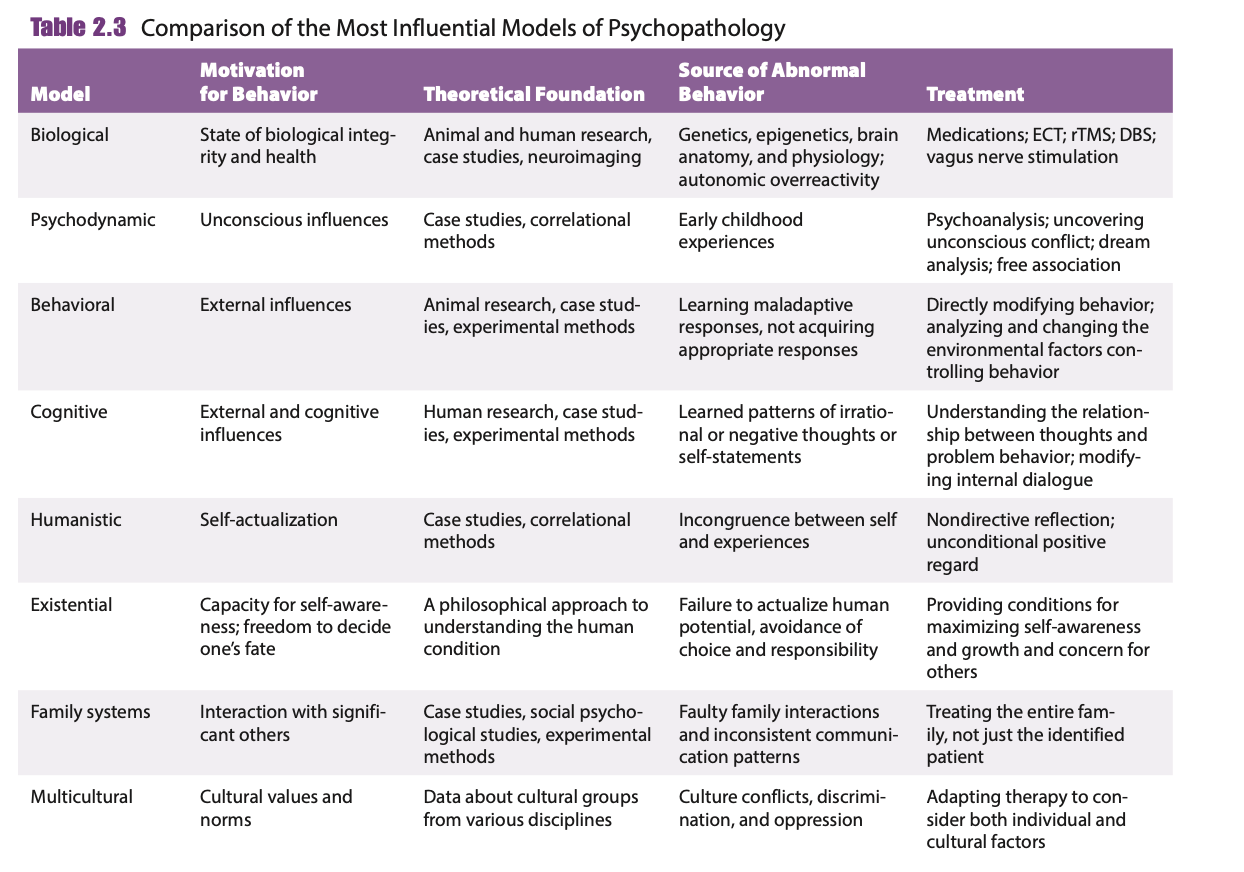
Models of psychopathology
• Biological, psychological, social, and sociocultural
Scientists now recognize that one-dimensional perspectives are overly simplistic
Biopsych model
Highlights the fact that interactions between biological, psychological, and social factors cause mental disorders
Limitations
• Does not focus on how these factors interact to produce illness
• Provides little guidance on treatment
• Neglects the powerful forces of culture
• Neglects sociocultural influences such as the effects of poverty or
discrimination in explaining mental disorders
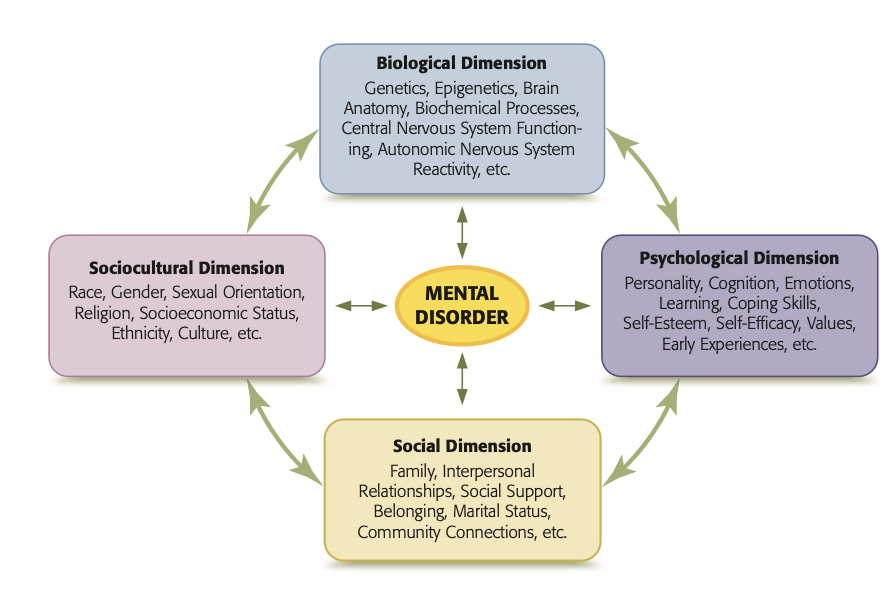
Multipath model
- Each dimension has explainations for distinct theories
- Each dimension can influence another
- Diff. comvos within the 4 dimensions may influence development of a particular condition
- Many disorders tend to be heterogeneous in nature
- Some triggers or vulnerabilities may cause different disorders
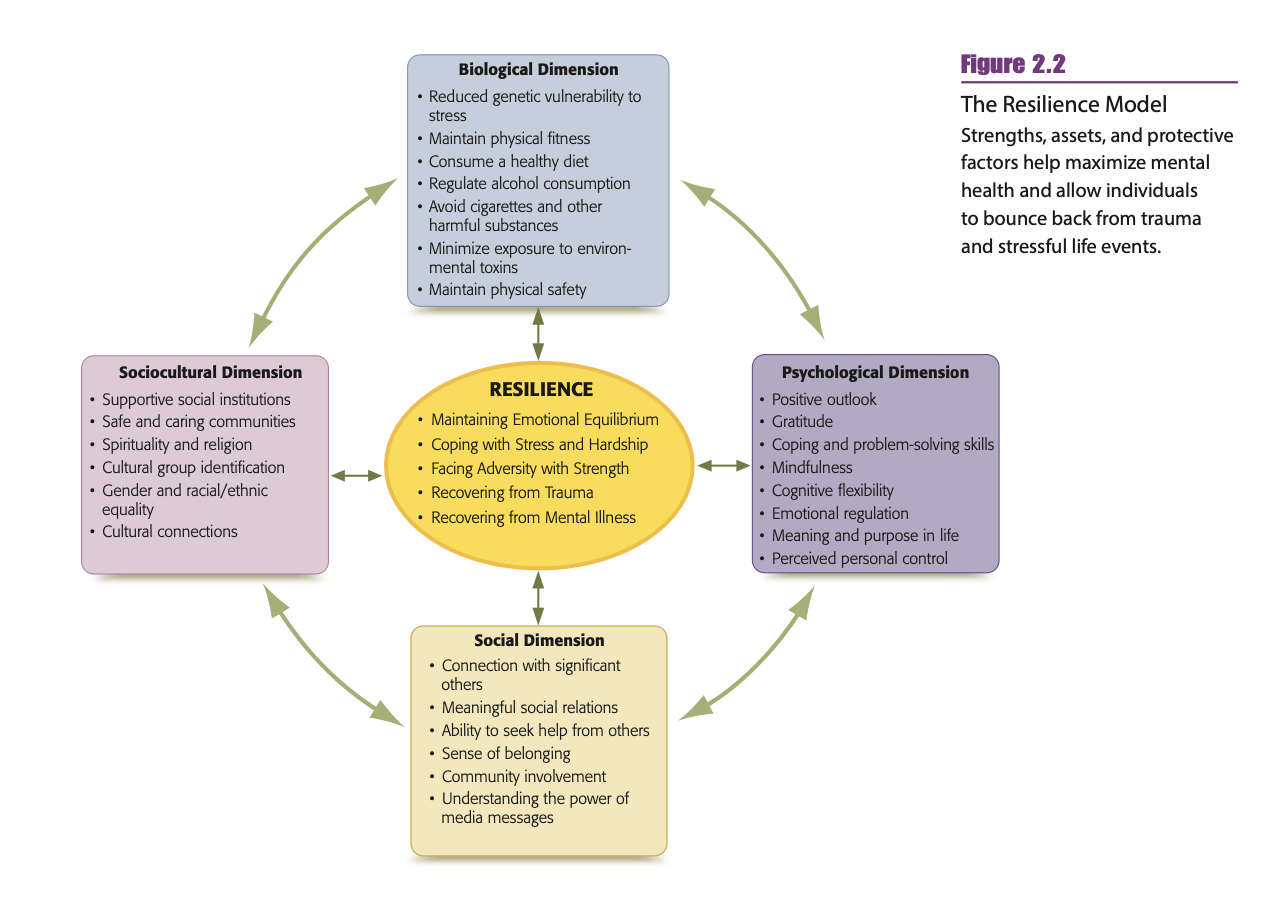
- It is equally important to remain aware of protective favrotrs that can improve mental health (The Resilience Model)
The Resilience Model
Chapter 3
Too lazy to take notes or even read this chapter
Intelligence tests
- Wechsler Adult Intelligence Scale, 4e
- 16 Years and older
- Stanford-Binet Intelligence Scale, 5e
- Ages 2 to 85
- Some psychologists believe that IQ tests largely reflect cultural and social factors rather than innate intelligence
- Fail to consider the effects of English language proficiency, culture, poverty, discrimination, and oppression
- Do not consider multidimensional attributes of intelligence
- Have a poor level of predictive validity
- Do not accurately predict future behaviors or achievement
- Motivation and work ethic may matter more
Tests for Cognitive Impairment
- Brain dysfunction can have profound effects on physical skills, such as motor coordination, as well as on cognitive skills
Bender-Gestalt Visual-Motor Test
• Involves copying geometric designs
• Certain drawing errors are characteristic of neurological impairment
• rotation of figures, perseveration, and inability to copy angles
Halstead-Reitan Neuropsychological Test Battery
• Differentiates patients with brain damage
• Can provide valuable information about the type and location of the
damage
Neurological Tests
- Allows noninvasive visualizations of brain structures
Structural imaging
• Computerized axial tomography (CT)
• Magnetic resonance imaging (MRI)
• Diffusion tensor imaging (DTI)
Functional imaging
• Electroencephalograph (EEG)
• Magnetoencephalography (MEG)
• Positron emission tomography (PET)
• Single photon emission computed tomography (SPECT)
• Functional MRI (fMRI)
Diagnosing Mental Disorders
Clinicians formulate diagnoses using a psychiatric classification system
- The symptoms must cause significant, distress, or impairment in social, occupational, or other important areas of functioning.
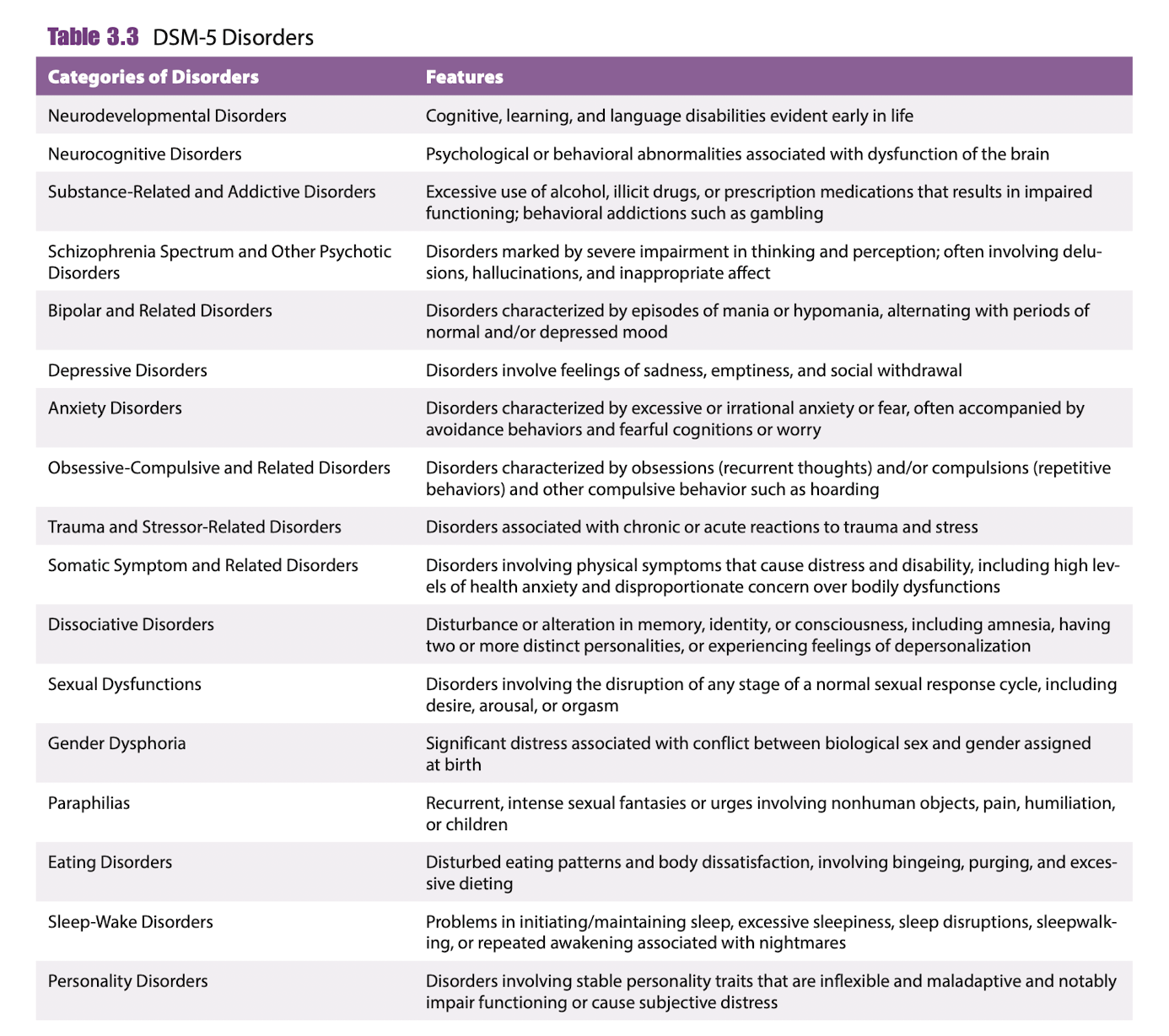
DSM-5 Disorders
Dimensional Perspective
DSM-5 is a categorical model
- Some professionals believe ineffective for diagnosis
- Individuals with a specific diagnosis often display a range of symptoms
- Some diagnostic categories have overlapping symptoms
- Certain disorders often co-occur (comorbidity)
Dimensional Classification System
- Disorders reside on a continuum from normal to severe forms of a disorder
- Disorder-based experiences do not constitute an “either–or” phenomenon
Table 2.3 (Page 72)