The Spinal Cord and Brainstem
- there are two, central and peripheral nervous systems
- CNS is brain and spine
- CNS is covered by bone, PNS is not
peripheral nervous systems
Somatic and Autonomic
- Somatic
- Pain and feeling
- Sensation and movement
- Autonomic
- Glands and organs
- Sympathetic and parasympathetic
- Sympathetic
- Arousal
- Parasympathetic
- rest, repair, and digestion
- Both used as toggle switch, bot participate in sex
- Glands and organs
The Spinal Cord
- More like a tail of the brain
- Very well protected by Vertebra
- Protected discs in between vertebra
- Manages some reflexes
- carries information
Brainstem I: The Hindbrain - Rhombencephalon
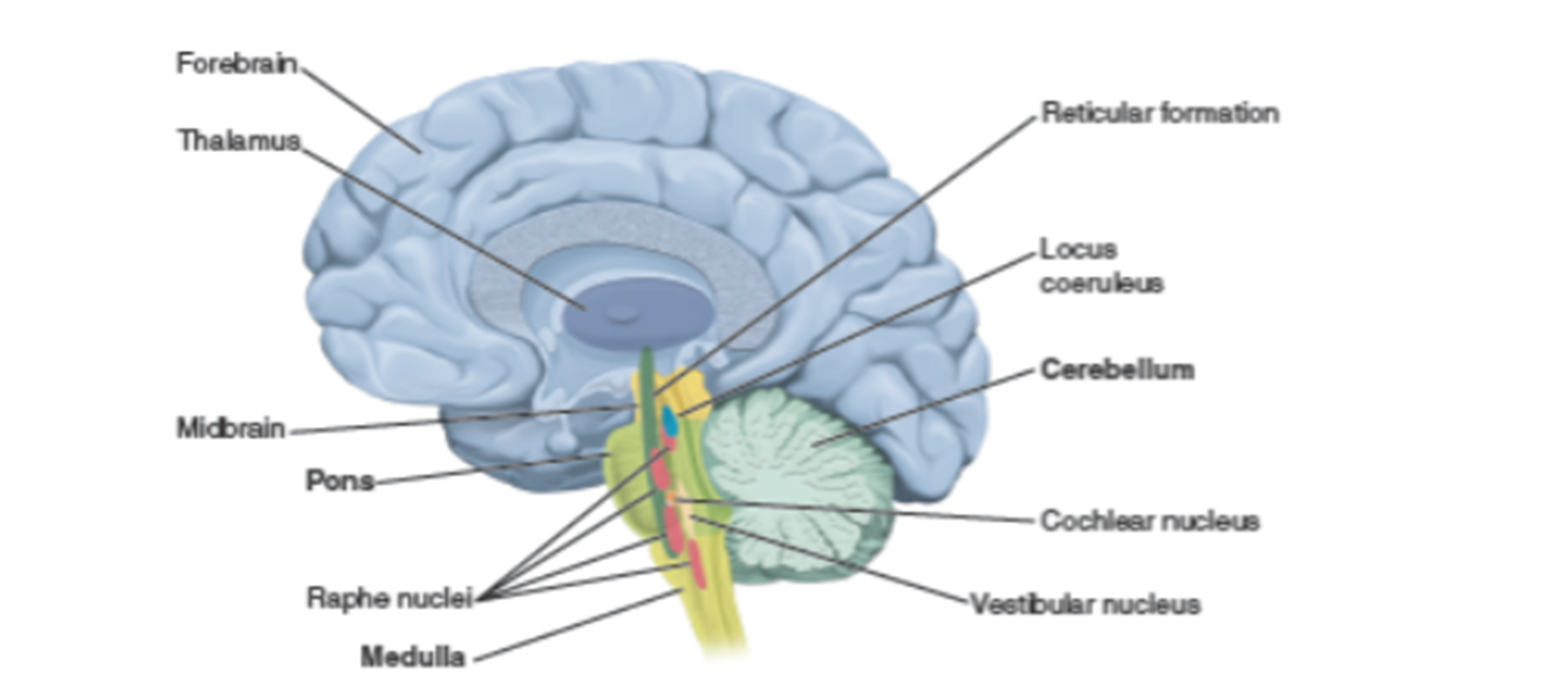
Medulla at bottom of brain (rostral): does info transfer
divides into two structures: the myelencephalon and the metencephalon.
95% of serotonin produced in gut, doesnt cross blood brain barrier
Pons is green buldge on brain stem
Locus coeruleus, look for trouble with ptsd
Cerebellum: skilled movements and imbalanced
- Influence go beyond that
- damage cause problems with cognitive functions
Reticular formation: sleep and consciousness, arousal, movement, pain - Medulla → Regulates vital functions such as heart rate, respiration, and blood pressure.
- Pons → Acts as a bridge for motor and sensory information between the brain and the spinal cord, and plays a role in sleep and arousal.
- Raphe nuclei → Involved in serotonin production and regulation of mood, sleep, and arousal.
- Locus coeruleus → Involved in norepinephrine production and plays a role in stress response, attention, and arousal.
- Cerebellum → Coordinates movement, balance, and motor learning.
Midbrain - Mesencephalon
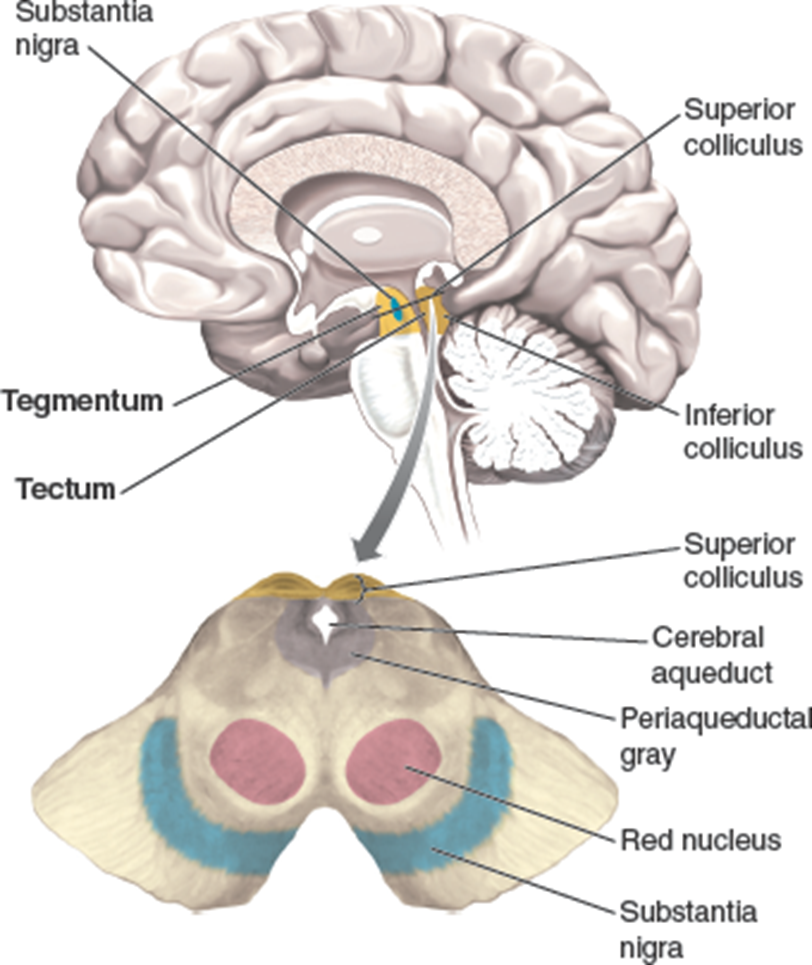
- Tectum - roof
- Cerebral aqueduct separates two.
- Tegmentum - floor
- Substantia nigra - black substance
- voluntary motor system
- Parkinson's we see distortion
- Periaqueductal gray → Involved in pain modulation and defensive behaviors.
- Superior colliculus → Processes visual information and helps coordinate eye and head movements.
- Inferior colliculus → Processes auditory information and plays a role in sound localization.
- Red nucleus → Involved in motor coordination, particularly controlling limb movements.
- Posture
Forebrain - Prosencephalon (Lecture 2.3)
https://www.youtube.com/watch?v=jVDNv0AZNTs
Diencephalon
- Thalamus
- Egg shaped
- Sensory Rely/ processing
- Info coming in from senses besides smell goes here
- Important to learning, mem, and consciousness
- Hypothalamus
- Hypo means below
- Below the thalamus
- major regulartory center
- homeostasis
- hunger, thirst, sex, aggression,, body temp
- Parietal lobe and temporal lobe
Telencephalon
- Basal Ganglia
- Plural for Ganglion
- Group project voluntary motor control
- Putamen
- Involved in motor control and learning motor skills.
- Works closely with the caudate nucleus as part of the striatum.
- Nucleus accumbens
- Central to the brain's reward circuitry.
- Plays a significant role in motivation, pleasure, and addiction.
- Globus pallidus
- Regulates voluntary movement by modulating motor signals.
- Acts as an output structure for the basal ganglia.
- Caudate nucleus
- Involved in motor processing, learning, and memory.
- Plays a role in goal-directed behavior and procedural learning.
- Decision to move made in prefrontal cortex
- asks this, is it good idea (based on reward and punishment)
Limbic System
- Hypothalamus
- Regulation of thirst
- Regulation of autonomic nervous system
- Regulation of endocrine system
- Septal area
- Sexual pleasure
- Pleasure
- Anterior cingulate cortex
- Fomix
- Redfiber, connecting mamal parts???
- Posterior cingulate cortex
- Decision-making
- Involved in error detection, emotion regulation, decision-making, and attention.
- Mammillary body
- Hippocampus
- Manage Stress
- Essential for learning and memory, particularly in forming and retrieving long-term memories
- Parahippo-campal gyrus
- Memory formation
- Amygdala
- Greek for almonmd (shape
- Tags sensory information as good or bad
- threat detector
- Very connected to hippocampus
- Plays a key role in processing emotions, especially fear and aggression, and in forming emotional memories.
- Olfactory bulb
- Under front lobes in cerebral cortex
Cerebral Cortex
The cerebral cortex is a thin, six-layered covering of the convolutions of the cerebral hemispheres.
- People who are asked to switch languages as they name objects don't show extra activation in the orbitofrontal cortex.
- Bark = Cortex
- Lobes of Cortex
- Frontal Lobe
- Big Executive, decision making, cognitive
- Orbitofrontal cortex
- Behind bony orbits protecting eyes
- Conscious
- Sense of right and wrong
- Lateral sulcus
- It separates the temporal lobe from the frontal lobe and the parietal lobe.
- Language processing
- Dorsolateral prefrontal cortex
- Attention in play from switching between stimuli
- Central sulcus
- Divides between frontal and parietal lobes
- Precentral gyrus (Primary Motor Cortex)
- Major gyrus
- Cells that implement movement once decisioon to move
- Parietal lobe is body senses
- Somatosenses
- Postcentral gyrus
- Primary somatosensory cortex)
- Occipital Lobe
- Vision
- Borrow other parts
- orders edges movement color shape
- use parietal lobe to utilize other senses
- Primary visual cortex
- Temporal Lobe
- Priamry auditory cortex here
- some visual processing
- face recognition
- object recognition
- Frontal Lobe
Four Commissures
- Corpus callosum
- Largest
- Anterior commissure
- Split brain to limit seizures
- Hippocampal commissure
- Connects tails of hippocampi
- Massa intermedia
- Dot in middle of thalamus
- Connect nuclei
- not everyone has one
Localizing Functions in the Cortex
- Lateralized language to left hemisphere
- 20% of left or ambi have it on right side or split between both
- logical deductive reasoning and basic computatioal is in left side
- right side is more emotional